ASTM E303 Slip Resistance Test Safety Criteria
If you’re looking to get an ASTM E303-22 DCOF slip resistance test done on your floor, tile or road by the American experts in this field, click on ASTM E303 slip resistance testing. We do coefficient of friction testing in our certified lab, and we test floors and roads all over North America and beyond with the pendulum slip resistance tester and other reliable DCOF rating instruments. It should be noted that the BOT-3000E is not reliable for assessing safety, and it lacks precision, but we can do testing with this flawed device as well if needed for a misguided “spec”. Reliable slip resistance testing is our specialty and we are one of the top three labs in the world, and our knowledge in this field is unmatched in the Americas. Email us for a quote to test on site at your location.
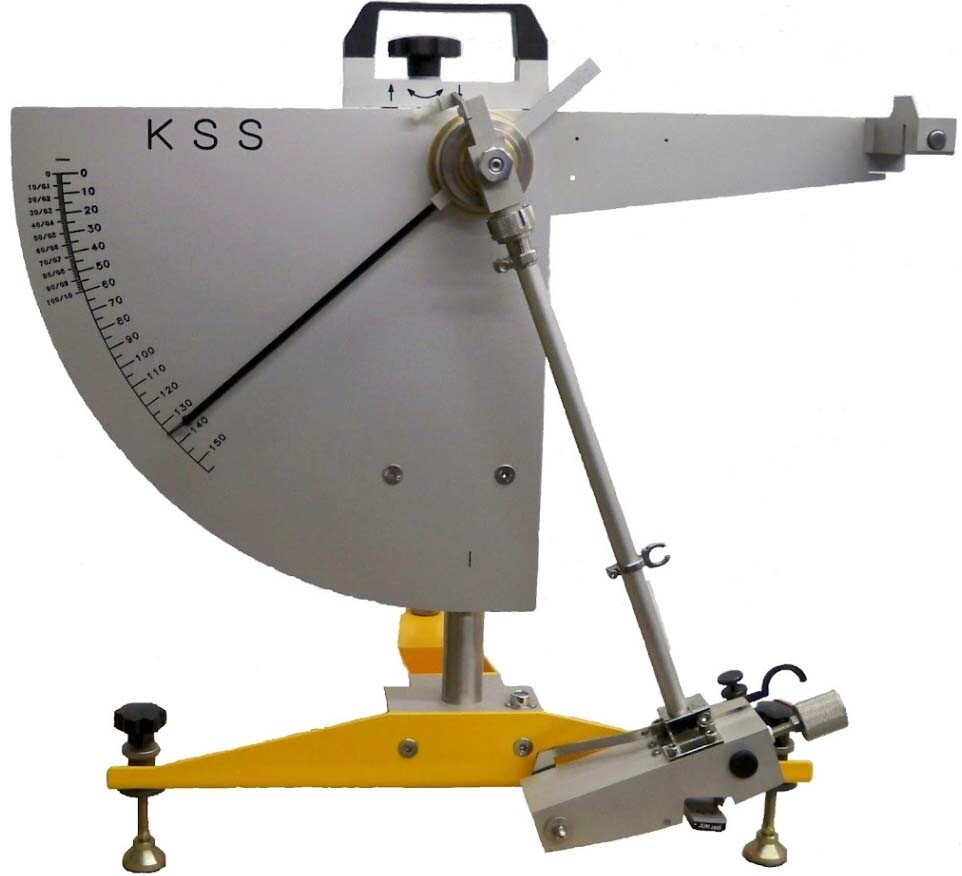
The newly revised ASTM E303 slip resistance test method (published in 2022) was created to determine the slip resistance of a flooring surface (or the skid resistance of a road surface) using the pendulum dynamic coefficient of friction (DCOF) tester (sometimes called the British Pendulum Tester). The official title of the test method is “ASTM E303-22 – Standard Test Method for Measuring Surface Frictional Properties Using the British Pendulum Tester”. This American slip resistance test method (first published as ASTM E303-93 in 1993) was shown to have precision and reproducibility between slip resistance testing labs (required by the ASTM) over 30 years ago now, unlike many other American slip resistance test devices (like the English XL and Brungraber Mark IIIB) popular with slip and fall expert “liars for hire” that use withdrawn ASTM standards that were withdrawn by the ASTM due to a lack of precision.
The usefulness and precision of pendulum DCOF slip resistance testing has just continued to improve over the decades, as it has been in use in well over 50 nations around the world for over 50 years now, which has led to well-researched safety criteria for pendulum DCOF test results. The latest version of ASTM E303 now more closely mirrors the pendulum slip resistance test methods used across the European Union (EN 16165, which superseded EN 13036), the United Kingdom, Australia (AS 4663, AS 4586), New Zealand, Singapore, Israel, China, India and numerous other nations that have been using the pendulum slip resistance test device for decades to determine the real-world slip resistance of floors and roads to help eliminate avoidable injuries and accidents. The pendulum DCOF tester is easily the world’s most widely-accepted, well-researched, and universally-trusted tribometer for measuring the frictional properties of a surface to assess safety, both in the lab and on site in the field. There have been numerous research studies done in many countries over the decades using the pendulum skid tester proving it’s precision and usefulness.
The video below shows the pendulum DCOF tester in action doing the ASTM E303-22 test method:
Floor Slip Resistance Testing with ASTM E303
Floor slip resistance test methods in the USA have historically been created to help sell slippery flooring in the United States, or help wealthy building owners defend the slip and fall lawsuits brought against them when they install polished, slippery floors that cause avoidable injuries. With this latest version of ASTM E303-22, the United States now has a reliable and trustworthy slip resistance test method for the use of assessing the actual real-world slipperiness of floors.
This is a big moment for American floor slip resistance testing, after numerous useless and highly misleading American floor friction test methods were either withdrawn or allowed to expire over the decades. Nonsense test methods were typically published by the American tile industry and expert slip and fall “liars for hire” (who run the ASTM F13 committee) such as ASTM C1028 (withdrawn), ANSI/NFSI B101.1 (expired), ANSI/NFSI B101.3 (expired), ASTM F1677 (withdrawn, for Brungraber Mark II, which became the almost identical Brungraber Mark IIIB), ASTM F1679 (withdrawn, for English XL), ASTM F1678 (withdrawn), ASTM F609 (withdrawn), ASTM F489 (a floor SCOF test with the James Machine, withdrawn in 2005) and on and on and on. These test methods only helped to create the slip and fall injuries that unscrupulous full-time slip and fall expert witnesses make their well-paid living with in American courtrooms.
The latest nonsense published by slip and fall “expert liars” is ASTM F2508, which is a way to falsely “validate” their “slip test tribometers” that lack any good science behind them, and have either a withdrawn ASTM standard or no standard at all anywhere on earth. For the test methods created by representatives of the tile industry, such as ASTM C1028 and ANSI A326.3, the goal is and was to help sell slippery tile, and then defend building owners who have installed it only to soon find themselves defending their slippery floors in court with the help of “liars for hire” using the English XL and Mark IIIB.
ASTM E303-22 changes all that. Now architects, building owners, specifiers and flooring manufacturers can make informed decisions based on internationally-approved science to help avoid slip and fall accidents happening on their properties before they find themselves needing to hire unscrupulous slip and fall “liars for hire”.
Interpretation of Results and Safety Criteria for Pendulum Floor Slip Resistance Testing
In the United States, ASTM standards don’t come with safety guidelines or recommendations (they’re just test methods), and the Americans with Disabilities Act (ADA) says floors should be “slip resistant”, but doesn’t define what that means. OSHA gives guidance based on meaningless misinformation they digested from expert court liars (mentioned above), and usually building codes are vague, misinformed, and change every few years. So Americans have been left to guess a flooring’s slip resistance, or ask the tile manufacturer what tiles are appropriate for areas that must be slip resistant. That’s often like asking a used car salesman if the old junker you’re looking at will keep reliably running for decades. A good salesperson will tell you whatever will get you to pull out your checkbook. But luckily the international floor slip resistance testing community has been working on safety guidelines for decades using the British Pendulum Tester.
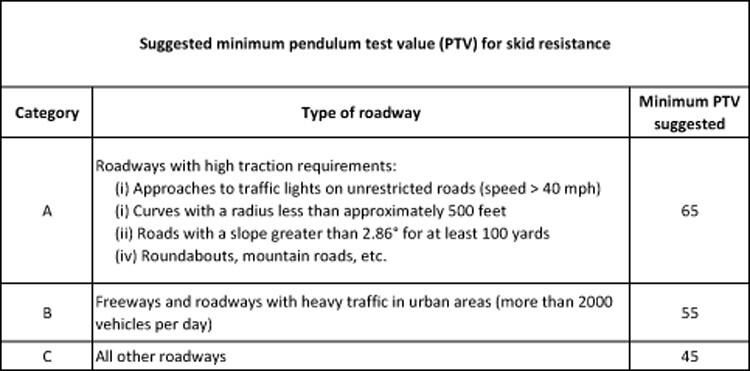
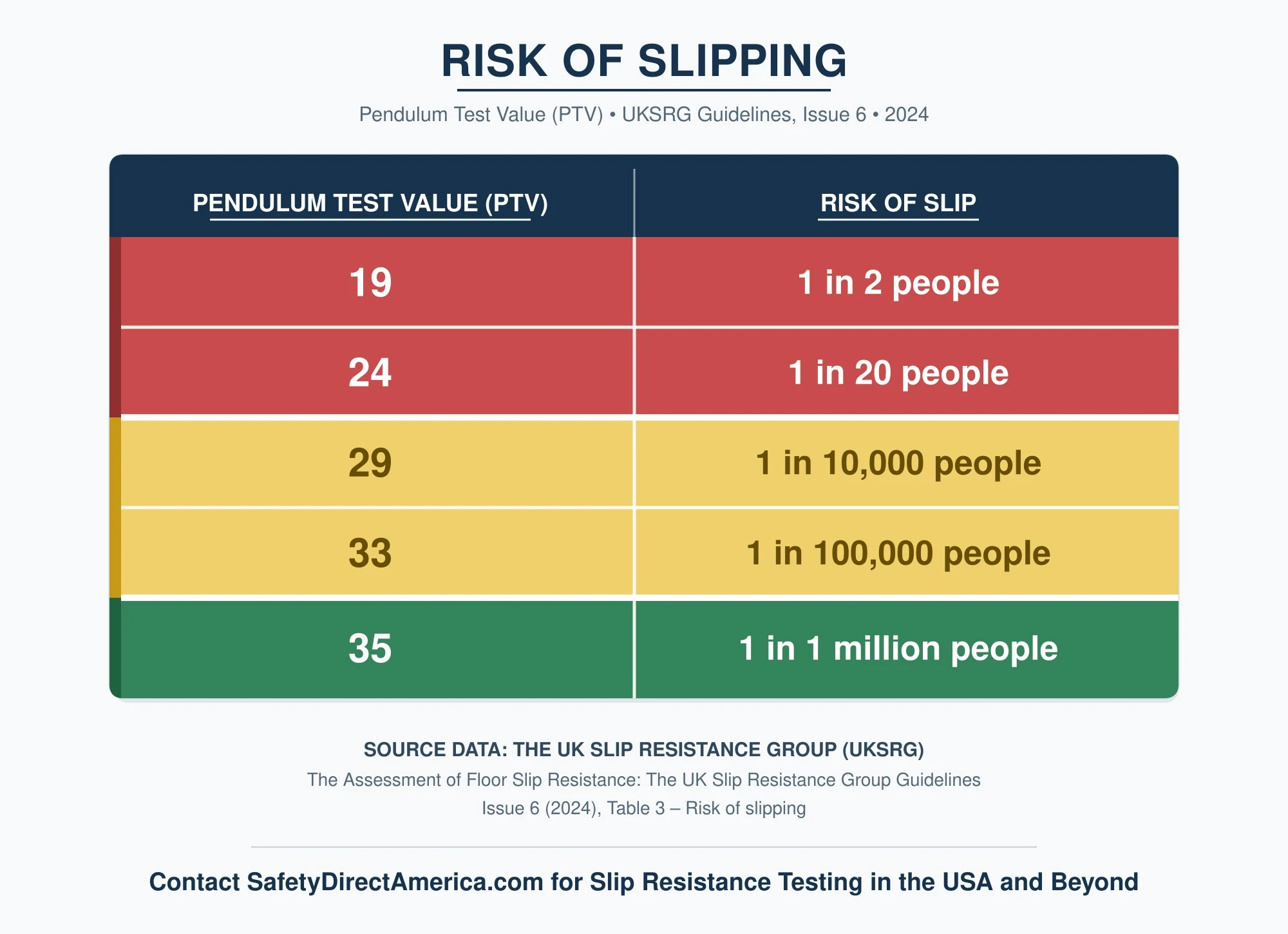
According to the American Floor Safety Alliance (AFSA), United Kingdom’s Health and Safety Executive (HSE), the Ceramic Tile Institute of America (CTIOA), and the United Kingdom Slip Resistance Group (UKSRG, of which our John C. Sotter is a contributing member), level floors that have a Pendulum Test Value (PTV) or British Pendulum Number (BPN) below 25 are considered “high slip potential”, flooring with a PTV between 25 and 35 are considered “moderate slip potential”, and level floors with a PTV above 36 are considered “low slip potential.” Higher PTV values mean better slip resistance. For floors with a slope (ramps and floors that need drainage, for instance), a mathematical calculation is used to calculate larger minimum safety criteria numbers based on the degree of slope. For instance, a floor with a slope of 2° would need a minimum PTV of 39 to fall into the “low slip potential” category, a floor with a 4° slope would need a PTV of 42.
To give it more perspective, the UKSRG, leaders in this field of study for decades, first released the chart below years ago and republished it in 2024 in their floor slip resistance testing guidelines:
Here’s a video of the pendulum DCOF skid tester in action:
Based on the Australian Safety Codes and Guidelines in HB198:2014(shown in link), different flooring areas will require different levels of slip resistance. However, their recommendations were at times confusing, offered maximum limits on each type of area for some unknown reason, and left out some crucial areas where a large percentage of serious slip injuries occur. For that reason and many more, the American Floor Safety Alliance AFSA was born in 2015, to be publish more up-to-date, more informative and precise pendulum slip resistance tests. For free. ASTM E303-22 is “good”, but AFSA FS101 pendulum slip resistance tests are fantastic. We are a group of international experts in one thing and one thing only: testing floors for slip resistance. Together, we have well over a hundred years of experience. We have pone of the world’s most brilliant pendulum manufacturers, we have advisors on three continents, but what we don’t have is full-time expert witnesses. They are generally experts in providing testimony in dozen of different fields of science, and no-one can be an expert in so many things at once. So we only allow full-time expert floor slip resistance testing professionals into the AFSA, ensuring we have the most up-to-date, most well-researched, and most precise test methods and recommendations to help stop slips around the world BEFORE they happen. The AFSA published a chart of recommendations based on research based on well over 50 years of research in the United Kingdom, Germany, Spain, Australia, New Zealand, and, of course, the experts at the American Floor Safety Alliance. Here is the most up-to-date version of those recommendation (click here for the floor safety recommendations in pdf):