Sustainable Slip Resistance
-
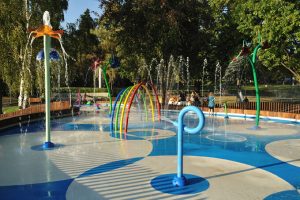
“Splash pads” are areas that contain water-play features and may contain play structures, but do not permit water to accumulate to any real depth. Their aliases include aquatic play pad, spray zone, spray pool, spray pad, spray deck, rain deck, and splash deck. There are 5,000–10,000 commercial or public splash pads in the USA, and…
-
Today, over 99 percent of supermarket floor areas are slippery when wet or otherwise lubricated. The lubricants may be water from tracked-in rain and snow; vegetable display sprays or a dripping ice bag; WD-40 from a customer’s test of a spray can; cooking oil; milk; or a very large variety of other liquids and solids.…
-
The September/October 2016 edition of SGIA Journal (Special Graphic Imaging Association), pp 89–92 has an article, “New Slip Resistance Specifications — Are You in Compliance?”, by the Marketing Manager of Mactac Distributor Products (“Technology that Sticks”, including indoor and outdoor floor graphics). He discusses the following about American National Standards Institute (ANSI) Standard B101.3: …
-
For over a decade, we have been on the search for a totally non-slip and very glossy floor coating that could help people who have had the misfortune of installing slippery tiles, or those who have slippery tubs or showers. We’ve seen several attempts over the years in our floor slip resistance testing business, but…
-
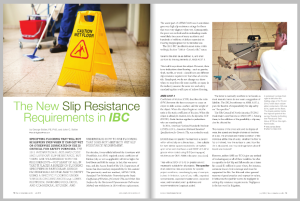
John C. Sotter and George Sotter of Safety Direct America were published in the July issue of The Construction Specifier magazine with an article talking about floor slip resistance and keeping floors safe for pedestrians. The article talks about the latest International Building Code (IBC) requirements for slip resistance, and its limitations as far as…
-
The U.S. federal government’s Consumer Product Safety Commission (CPSC) is considering a petition requesting rule making to require that manufacturers of floor coverings, floor coverings with coatings, and treated floor coverings label their products’ slip resistance in accordance with an ANSI/National Floor Safety Institute (NFSI) standard, B101.5. (NFSI, Safety Direct America and others offer for-fee…
-
The 2012 International Building Code changed slip resistance requirements for indoor floors that may get wet in use. The previously-used ASTM C 1028 friction test method is obsolete, and testing using the AcuTest method in ANSI A137.1 slip test must show a minimum of 0.42 wet dynamic coefficient of friction — but many other factors…
-
The National Safety Council’s (NSC) latest published statistics show that falls are causing 28,000 deaths in the USA annually (see p. 19 of their report). This is the equivalent of a 9/11/2001 attack every six weeks, all year long. Moreover, falls deaths are approaching motor-vehicle deaths. Safety Direct America offers products and services that can…
-
Flooring that gets high foot traffic and can get wet or greasy in use needs slip resistance (or skid resistance) that stands up well under wear rather than losing its wet slip resistance after a few weeks. McDonalds Restaurants spent years in research and devised a laboratory slip test that assesses how well the wet…